
NJ’s REAL Rules Are Here: The Complete Timeline and What It Means for Flood Insurance Premiums

New Jersey is fundamentally changing how we develop our coastlines and manage flood risk. Spear headed by the NJDEP, the Resilient Environments And Landscapes (REAL) rules represent a massive shift to address future climate reality, rather than relying solely on historical data.
This is not a theoretical change—the clock is ticking.
For developers, property owners, and the state’s insurance professionals, understanding the critical milestones is essential. Here is the definitive timeline of the REAL rules and a clear analysis of their complex relationship with flood insurance.
The NJ REAL Rules Roadmap: From Proposal to Enforcement
The implementation of these regulations has been a multi-year process. If you have active projects, pay close attention to the upcoming deadline.
📅 Milestone 1: The Initial Proposal (August 5, 2024)
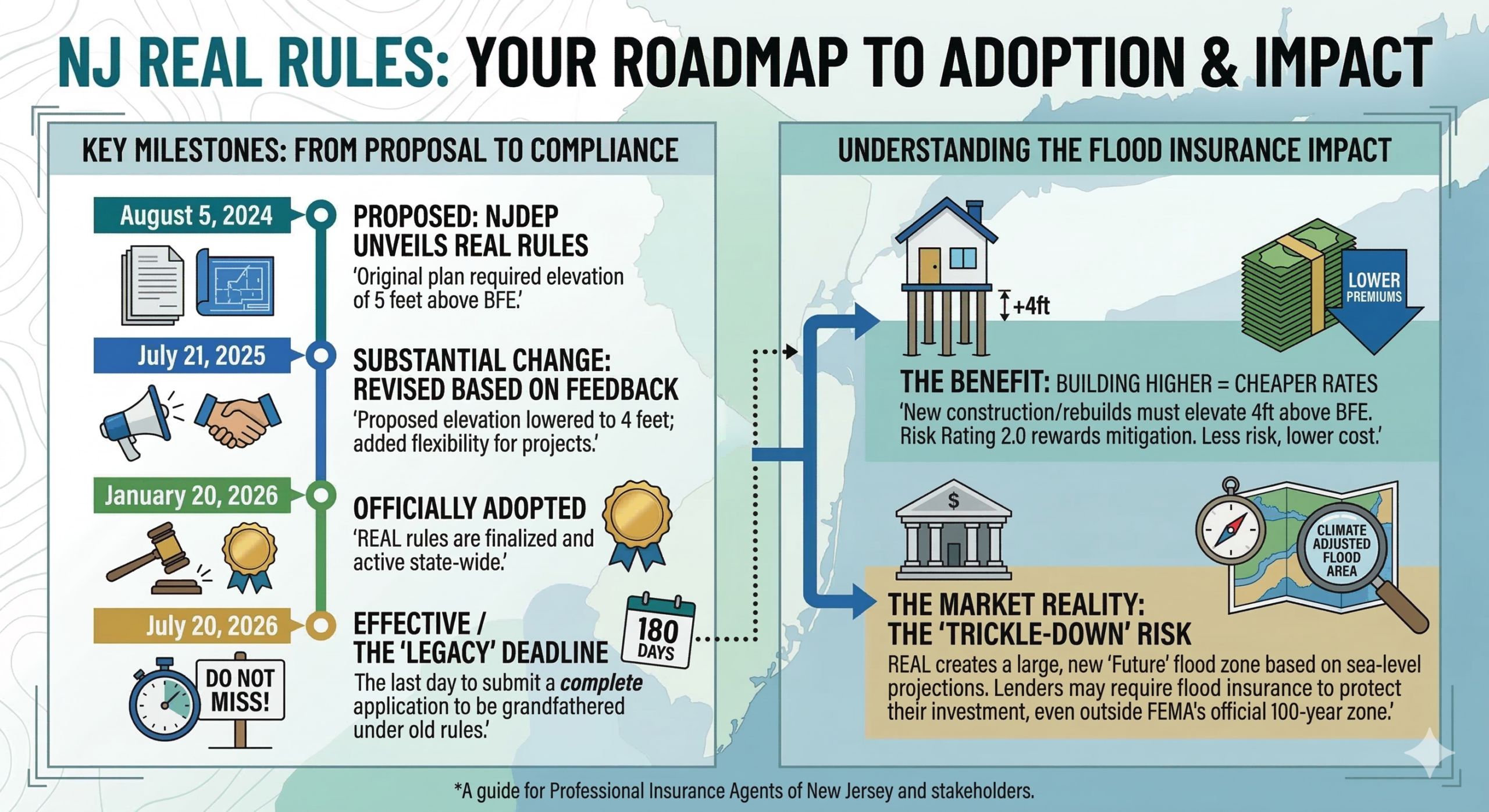
The NJDEP kicked off the formal rulemaking process by publishing an enormous 1,044-page original proposal. It laid out ambitious goals, including requiring structures to be built 5 feet above FEMA’s current Base Flood Elevation (BFE).
📅 Milestone 2: Notice of Substantial Change (July 21, 2025)
After an intense public comment period with significant stakeholder feedback and debate, the NJDEP modified the plan. The key revision was lowering the design elevation requirement from 5 feet down to 4 feet above the BFE. It also introduced critical flexibility for affordable housing projects.
📅 Milestone 3: Official Adoption (January 20, 2026)
Following the revisions, the final REAL rules were officially adopted and became active. While the rules are technically “in effect” as of this date, a crucial grace period was included.
📅 Milestone 4: The 180-Day Legacy Deadline (Effective Date)
The date your clients care about is July 20, 2026.
This is the last day that a technically complete permit application can be submitted to the NJDEP to be grandfathered under the old land-use regulations. Any new application submitted on or after July 21, 2026, will be subject to the strict new REAL standards, including the expanded Climate Adjusted Flood Hazard Area.
The Big Question: How Will REAL Rules Impact Flood Insurance?
This is where understanding the difference between state zoning laws and federal mandates is vital for risk managers and PIANJ members. The impact is nuanced:
1. The Myth: The State is Mandating Flood Insurance
Fact: The NJ REAL rules do not mandate flood insurance. The NJDEP has been clear: these rules are land-use and design standards. They do not rewrite FEMA flood maps. Only a federally-backed mortgage lender can mandate flood insurance based on current FEMA data.
2. The Benefit: Long-Term Premium Savings for Compliance
For properties that must comply with the REAL rules (e.g., new construction, or a “substantial improvement”), the insurance impact will be highly beneficial.
-
Because REAL forces structures to elevate to 4 feet above the BFE, the resulting home is considered low-risk.
-
Under FEMA’s Risk Rating 2.0 methodology, premium calculations heavily weight elevation. A compliant home (BFE+4) will secure a significantly lower flood insurance premium than an older, non-compliant home in the same zone. The higher investment in construction secures long-term affordability.
3. The Risk: Market Pressure and Lender Mandates
While the state isn’t forcing individuals to buy policies, the financial market might act anyway.
-
To enforce the REAL rules, the state created a new map of New Jersey: The Climate Adjusted Flood Hazard Area. This area maps future inundation risks looking ahead to the year 2100, which is often much larger than FEMA’s current 100-year floodplain.
-
Risk-aware mortgage lenders may review the state’s new inundation data. If a property is outside of FEMA’s official mandatory insurance zone, but inside New Jersey’s newly declared future high-risk zone, a lender may proactively mandate flood insurance anyway to protect their investment.
Conclusion: Don’t Wait for the Tide to Rise
New Jersey is charting a course toward a resilient future. For properties in coastal or flood-prone areas, the REAL rules are a wake-up call.
Your network of engineers, builders, and Professional Insurance Agents of New Jersey is essential now more than ever. Consult with experts immediately to see if your active projects can meet the July 20th deadline, or to model the premium benefits of building resiliently.
Blog